The Monumental Fountain of Side, also known as the Side Nymphaeum, is one of the largest surviving Roman fountain structures in Türkiye. Located beside the entrance of Side Ancient City, the 2nd century AD monument remains one of the most recognizable historical landmarks in Side today.
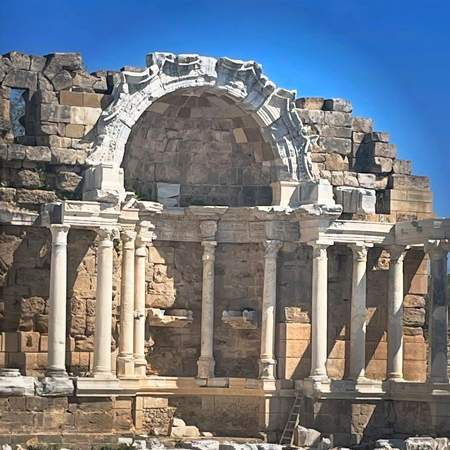
The Monumental Fountain of Side, also known as the Side Nymphaeum, is one of the largest surviving Roman fountain structures in the Antalya region of Türkiye and the biggest ancient fountain in Pamphylia. It stands beside the main entrance of Side Ancient City and was built during the Roman period as both a public water source and a monumental entrance structure.
Construction of the fountain began during the reign of Roman emperor Antoninus Pius in the 2nd century AD, when Side was one of the most important harbour cities in Pamphylia. Merchants, travelers and officials arriving from the mainland first passed this enormous marble-covered facade before continuing deeper into the ancient city. Today, the monument remains one of the best known Side attractions.
The fountain was both part of the city’s water system and an architectural symbol of Roman Side’s wealth and development.
The word “nymphaeum” comes from Roman architecture and describes monumental public fountain buildings decorated with columns, statues and water basins. Because of this architectural style, the Monumental Fountain of Side is historically known as the Side Nymphaeum.
Today, both names refer to the same structure. Most tourists search for “Monumental Fountain of Side,” while archaeological and historical sources more commonly use the name “Side Nymphaeum.”
The Monumental Fountain distributed water arriving through the city’s aqueduct system and also marked the northern entrance of Side Ancient City.
Large public fountains were common in major Roman cities throughout Asia Minor. Side invested heavily in public architecture during this period, including the fountain, Roman Theatre and main colonnaded streets.
Archaeologists also discovered relief scenes connected with the Epibaterios festival near the basin area, suggesting the monument played a role during ceremonies and public gatherings.
The fountain received water through a large aqueduct system connected to the Melas River, known today as the Manavgat River. The water source was located approximately 30–40 km from Side.
Water entered through hidden clay, lead and marble pipes installed behind the facade walls. Archaeologists later discovered fragments of these original pipelines during restoration works.
The facade originally contained nine water outlets inside three large semicircular niches. Water flowed through marble decorations and lion-head sculptures before collecting in the large basin in front of the monument.
The Monumental Fountain of Side measures approximately 35–50 meters in length, making it the largest ancient fountain structure in the Pamphylia region. In its original form, the structure rose across three levels and may have reached around 15–20 meters in height.
Today, roughly 1.5–2 levels survive, with sections of the facade still reaching around 5 meters high.
Many visitors are surprised by its size because the structure looks more like a Roman ceremonial facade than a traditional fountain.
Visitors can still see large semicircular niches, restored Corinthian columns, marble entablatures, water channels and the massive rectangular basin in front of the structure.
One of the most important restoration achievements has been the reconstruction of 24 original columns using authentic architectural blocks recovered from the site. Archaeologists used anastylosis restoration methods, meaning surviving original pieces were reassembled instead of modern replicas being added.
The restoration project has continued since the early 2000s and uses nearly 900 original stone blocks recovered from the area. Major conservation work around the fountain and basin sections continues during the 2025–2026 period.
Information boards near the site also show historical explanations and 3D reconstructions of how the fountain looked during the Roman era.
For most travelers, the Monumental Fountain creates the first major impression after entering Side Ancient City. The structure appears immediately beside the pedestrian route as a huge Roman stone facade near the entrance area.
Most visitors stop for around 5–10 minutes to photograph the columns, examine architectural details and continue toward the Roman Theatre and harbour district. Many travelers visit the site during organized Side cultural tours covering the main archaeological landmarks of the region.
The enormous scale of the structure helps visitors understand how advanced Roman public construction had already become nearly 2,000 years ago.
The Monumental Fountain is one of the best photography locations near the entrance of Side Ancient City. Wide panoramic photos work especially well because of the scale of the restored columns and facade.
Most visitors take photos from the edge of the basin facing upward toward the columns. Late afternoon and sunset usually provide the best lighting conditions.
After dark, architectural lighting illuminates the niches and facade, making the monument especially popular for evening walks through the ancient city during summer.
The Monumental Fountain stands at the beginning of the main archaeological route through Side Ancient City. Just a short walk from the fountain, visitors can reach several of the most important Roman landmarks in Side.
Most visitors continue walking south from the fountain along the ancient Column Street toward the Roman Theatre and the harbour district. Along the route, travelers pass remains of Roman roads, columns, shops and Byzantine structures spread throughout the archaeological zone.
Travelers interested in visiting more historical places around the region also often visit Aspendos Ancient City, one of the best preserved Roman theatre complexes in Türkiye.
The Monumental Fountain stands on the northeastern side of Side Ancient City near the main entrance gate and close to the Side Otogar transport area.
The structure is positioned beside the beginning of the ancient Column Street leading deeper into the peninsula.
Because of its location, the fountain becomes the starting point for most walking routes through Side Ancient City.
Most tourists arrive from the main parking and visitor center area near Side Otogar. From there, visitors walk approximately 150 meters before reaching the fountain.
Travelers arriving by dolmus, tour bus or rental car typically enter the archaeological zone from this direction because vehicle access inside the old town is restricted.
The Monumental Fountain of Side can be visited free of charge. No museum ticket is required because the structure stands in the open archaeological zone outside the paid Side Museum and Roman Theatre sections.
The area around the fountain is accessible for strollers and wheelchairs thanks to modern paved walkways. However, uneven ancient stone surfaces outside the main paths may be difficult to cross.
The main parking area for Side Ancient City is located near the visitor center beside Side Otogar. From there, the walk to the monument takes approximately 2–3 minutes.
The best time to visit is before 08:30–09:00 in the morning or after approximately 17:30–18:00 in the evening. During these hours temperatures are lower and the area is less crowded.
Between 10:00 and 16:00 the entrance area often becomes busy because of tourist buses and excursion groups arriving from nearby resort regions.
Since the monument stands fully in open sunlight, bringing water, sunglasses and sun protection during summer is strongly recommended.
The Monumental Fountain of Side is worth visiting as part of a wider walk through Side Ancient City. Its enormous scale and restored Roman architecture create a strong first impression immediately after entering the archaeological area.
Most travelers continue from the fountain toward the Roman Theatre, harbour district and Temple of Apollo. Visitors interested in seeing several historical sites in one day often choose the Side Aspendos Manavgat Tour, which combines important Roman landmarks and natural attractions around the Side region.
Yes. The Monumental Fountain stands in the open archaeological zone of Side Ancient City and can be visited without a museum ticket.
The fountain was built during the 2nd century AD in the Roman period, approximately 1,800–1,900 years ago.
The monument is located beside the main entrance of Side Ancient City near Side Otogar and the beginning of Column Street.
Visitors can walk very close to the facade and basin area, but climbing onto the ruins and entering protected sections is prohibited.
Most visitors spend around 5–10 minutes at the monument before continuing through the ancient city.
Yes. Evening lighting illuminates the facade and columns, making the area popular for night walks and photography during summer.
Excursions near Side include boat tours, Green Canyon and rafting within 30–90 minutes tra
Choosing excursions in Side depends on your available time, travel distance and preferred
Main attractions in Side with travel tips and nearby tours. Plan what to see and book excu
Cappadocia from Side is about 474 km away and is known for its rock formations, undergroun
Side beaches include sandy areas with different sea entry, crowd levels and facilities. Th
Discovery Park in Side is a family-oriented theme park with dinosaurs, animals, and short
Fishing in Side Turkey is possible offshore, on the Manavgat River, and from the shore. Ea
September is one of the best months for tours in Side. The sea stays warm, the heat is low
Green Canyon is located about 27 km from Side and is known as one of the most relaxed natu
Aspendos Ancient City is one of the most visited historical attractions near Side in Türki


 Engilish
 Русский
 العربية
 Polski
 Deutsch
 Norsk
Norsk
 Français
 Türkçe